Research Team
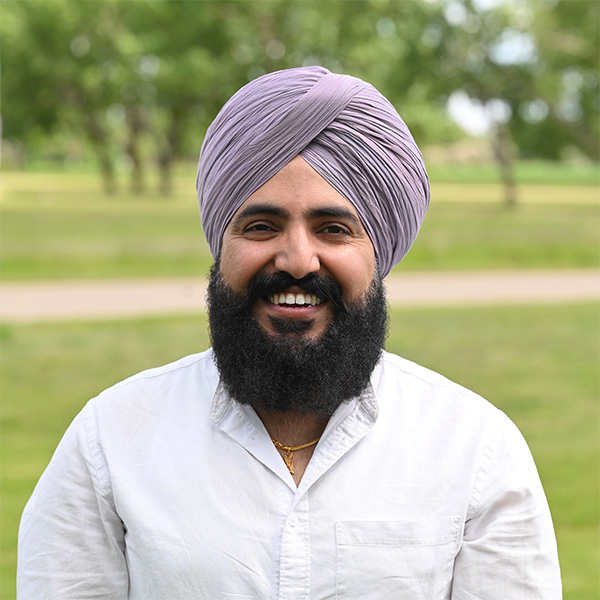
Gurcharn Brar Principal Investigator
I grew up in Punjab, India’s “breadbasket,” where I completed a B.Sc. in agriculture (honours in crop protection) at Punjab Agricultural University. In 2012, I moved to Canada’s breadbasket, Saskatchewan, and completed my M.Sc. and PhD in wheat genetics and breeding at the University of Saskatchewan. In January 2020, I joined the University of British Columbia as an Assistant Professor in the Faculty of Land and Food Systems. In January 2024, I took up a new position as Assistant Professor in the Department of Agricultural, Food and Nutritional Science at the University of Alberta.
Jawad Awan Postdoctoral Fellow
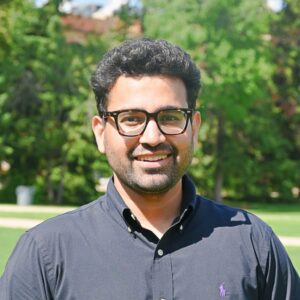
Muhammad Jawad Akbar Awan is a plant molecular biologist and genome editing specialist, currently serving as a Postdoctoral Fellow in the Cereal Breeding Lab at the University of Alberta, Canada. His research is centered on the application of CRISPR-Cas systems for improving yield, stress tolerance, and nutritional quality in major crops, including wheat and barley.
He earned his Ph.D. in Biotechnology from the National Institute for Biotechnology and Genetic Engineering (NIBGE), a constituent college of Pakistan Institute of Engineering and Applied Sciences (PIEAS), where he developed integrative genome editing and breeding strategies to enhance wheat productivity. His postdoctoral work continues this trajectory, focusing on multiplex CRISPR applications and transformation systems for precise crop improvement. His technical expertise spans CRISPR-Cas technologies, virus-based genome editing, tissue culture, molecular cloning, and in silico protein and genome analysis. He remains deeply committed to translational plant science that addresses global food security and climate resilience.
Tracy Gartner Program Manager
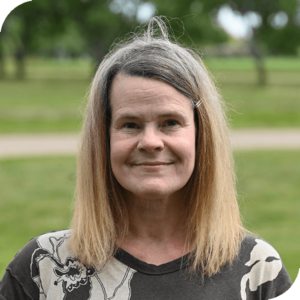
I was raised in rural Alberta with a strong love of nature. I hold a diploma in Business Administration from Lakeland College and a BSc in Environmental Biology from the UofA.
I have worked at the UofA in various administrative capacities for 20 years and have been with the wheat breeding group at the UofA for 15 of those years. In this capacity, I am responsible for grant administration, HR activities, and general administrative support.
Samuel Holden Post-Doctoral Fellow: Genomics and Bioinformatics Lead
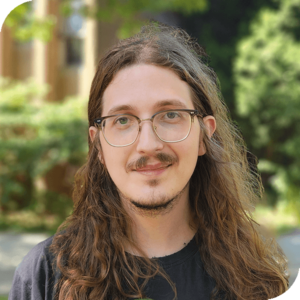
Sam Holden completed his PhD with Matthew Moscou at The Sainsbury Laboratory UK, where he studied resistance to non-adapted stripe rusts in barley, as well as investigating the origin and evolution of the Exo70FX family of exocytosis genes in the Poaceae (grasses). He is now a bioinformatician in the CBL group, where he works on plant and pathogen genome assembly, genetics, transcriptomics, and helps to support the rest of the group with training in these areas. Currently he is investigating the role of somatic hybridisation in the origin of North American stripe rust lineages, and the links between genome organisation and gene expression in wild wheat relatives.
Tehreem Hussain WISEST Summer Student
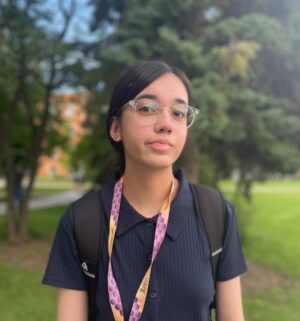
Tehreem Hussain is a student entering Grade 12 with an interest in biology and genetics. She is excited to be part of the Cereal Breeding Lab and to gain hands on research experience on crop breeding and agricultural biotechnology.
Muhammad Iqbal Research Associate: Assistant Wheat Breeder
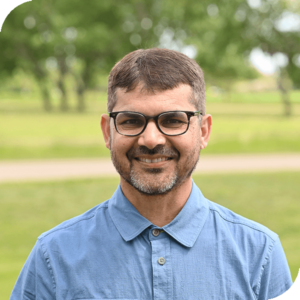
I hold a M.Sc. degree in Agriculture, from the University of Agriculture, Peshawar, Pakistan, and a PhD degree in Plant Science from the University of Alberta, Edmonton, Canada, obtained in 2006. I commenced my career as a Wheat Breeder/Researcher at the National Agricultural Research Centre,Islamabad, Pakistan in 2001.
My primary role, at the Cereal Breeding Lab of the University of Alberta, is to assist in the development of spring wheat varieties endowed with increased grain yield, superior end-use quality attributes, and enhanced genetic resilience against diseases and environmental stresses. Over the past decade, my research has centered on understanding the genetic bases and improving agronomic, disease resistance(common bunt, Fusarium head blight, leaf, stem, and stripe rusts), as well as refining end-use quality traits in western Canadian wheat.
My research interests revolve around pinpointing genomic regions governing early maturity, grain yield, disease resistance, and end-use quality traits in bread wheat. Furthermore, I am keen on gene/QTL pyramiding to develop improved wheat germplasm.
Omar Janmohamed Volunteer Lab Assistant
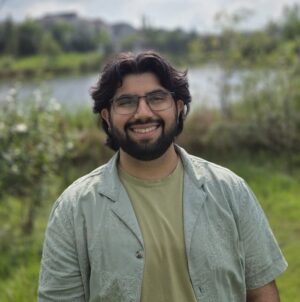
I am a fourth year student at the University of British Columbia in the Global Resource Systems program. As a student of agriculture, I am committed to understanding and developing ways to make our food systems more resilient to the growing environmental and ecological pressures faced by farmers, which influence both the supply chain and the environment depending on how these challenges are addressed. At the CBL, I am expanding my understanding of plant breeding and the intricate system of plant genetics used to develop cereal crops that are more resistant to pathogens.
Naveen Kumar Postdoctoral Fellow
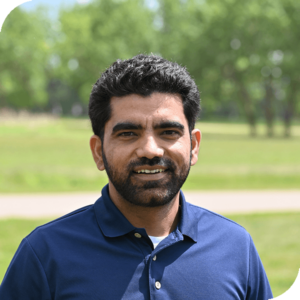
Having been raised on a farm as a farmer’s kid, early in my childhood I have developed a deep appreciation for agriculture and the importance of resilient crops. Everything started to come together during my high school when I began the genetics unit in my biology class. Here I was instantly allured by the idea of genes and how they could hold such a great bearing on crops.
Eventually, I discovered the story of Norman Borlaug and how he used genetics and plant breeding to save millions during green revolution. To pursue my passion in agriculture, I did my B.Sc. and M.Sc. in agriculture (crop breeding) at Punjab Agricultural University. I earned my Ph.D. in crop physiology from Virginia Tech, USA, where I focused on breeding peanut for drought tolerance. I was drawn to cereal research because of its critical importance in global foodsecurity and my passion for sustainable agriculture.
As a Postdoctoral Fellow at cereal breeding lab, I am dedicated to identifying novel sources of resistance to priority diseases and pre-breeding of wheat for multiple disease-resistant traits. I have been working with this dynamic research group for one year, and I am excited to contribute further for developing disease resistant Canadian wheat cultivars
Gabriel Hilario Maulaz Lacerda Volunteer Lab Assistant
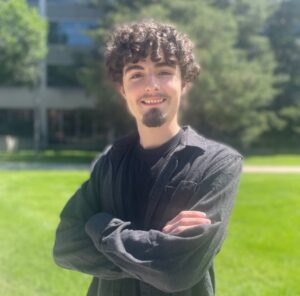
I am a BSc Immunology & Infection Honours student at the University of Alberta. As a Brazilian, I view the agricultural sector as vital, and I believe that the use of genetic tools to protect crops not only strengthens the economy but also plays an essential role in combating world hunger by keeping pest resistant varieties up to date. I am currently a laboratory assistant with aspirations to begin research in the CBL lab, contributing to the molecular development and protection of Alberta’s agricultural systems.
Meng Li Postdoctoral Fellow
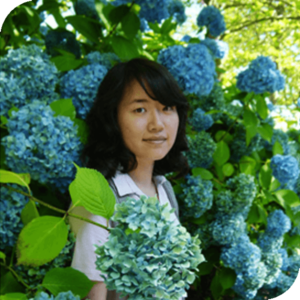
I graduated from Peking University, School of Life Sciences as a Bachelor of Biology, and earned my MSc and PhD in Botany, University of British Columbia. Over the last decade, my research areas focus on plant immunity and crop disease management including molecular and cellular biology, host-pathogen genetics and biochemistry. Currently, at CBL,I continue working on genomic analysis and marker-assisted breeding of Canadian wheat cultivars.
Joseph Moss Research Technician
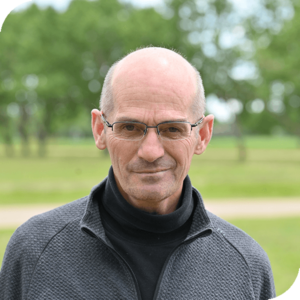
I was brought up on Pick Your Own (PYO) farm in southwestern Ontario. We grew 20-25 acres of strawberries, 5 acres of raspberries, we also grew tomatoes, cantaloupe, rhubarb, spinach, broccoli, cauliflower and other crops.
This experience led me to the University of Guelph where I completed an Associate Diploma of Agriculture majoring in Horticulture. I continued at the university and completed a BSc. (Agr) majoring in business. While doing my degree, I also got a job with Rhone Poulenc which gave me a great experience in agricultural small plot research.
Currently, I am permanent employee at the University of Alberta as a research technician since 2013. I work well as a team player and I am involved in outdoor work such as preparing for seeding, maintaining field plots, and harvesting, drying and organizing seed. I am comfortable driving large machinery (tractors and combines) with my background in farming.
Harmeet Singh MSc Student
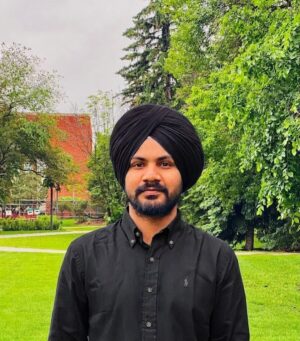
I come from a farming family in Barnala, Punjab, India and grew up with a close understanding of agricultural life long before pursuing it academically, observing the demands of sowing and harvest and the impact that crop performance has on a farming household.
I completed my B.Sc. (Hons.) in Agriculture at Punjab Agricultural University (PAU), Ludhiana, where I developed a strong foundation across plant breeding, agronomy, soil science, plant pathology, entomology and horticulture. It was during this program that I developed a particular interest in plant breeding, recognizing its central role in improving crop productivity and resilience for farming communities such as my own.
I am pleased to be part of the Cereal Breeding Lab, where I am able to pursue this interest through applied research. My current work examines the effects of genetics and agronomic practices on wheat quality, an area situated at the intersection of crop management and end-use value, with direct relevance to producers and the broader food supply chain. This research builds on my long-standing interest in field crop improvement and I am committed to contributing to sustainable cereal production in Canada and beyond.
Jasneet Singh PhD Student
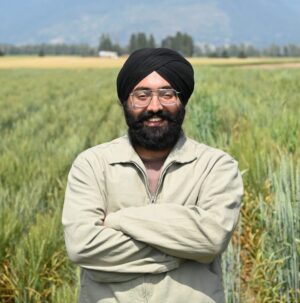
I’m a curious human driven by real-world impact. I earned my bachelor’s and master’s from Punjab Agricultural University, where I added my two cents in developing aerobic direct seeded rice, an alternate for reducing rice’s heavy water consumption while sustaining yields. My experiences at PAU, seeded a curiosity and a sense of awe, which probably resonated with some inherent temperamental inclinations. It gave me a profound insight into the challenges facing global food systems, and the critical role genomics plays in addressing these issues.
This fuelled me to undertake PhD and look for a research-based career. I’m fortunate to be a part of CBL, one of Canada’s premier wheat breeding program, focussing on scouting, transfer and pyramiding of genes/QTLs that impart resistance or offer an opportunity for breaching the yield barriers.
For my PhD, I’m venturing to explore novel sources of resistance to Canada’s top-priority wheat disease, stripe rust, by tapping into underutilized wheat relatives and landraces. I’m excited to join the wheat rust research community and contribute to staying ahead of these rapidly evolving pathogens. The recent breakdown of Yr15 in Europe, once considered one of the most robust stripe rust resistance genes, underscores a perfect rational for continual discovery of new resistance sources.
Angelo Smrylis NSERC Undergraduate Researcher

I am an undergraduate student entering my fourth year who has been drawn to genetics ever since high school. Since starting at the University of Alberta, I have been driven to explore how molecular techniques are used for crop improvement. Now, as an NSERC undergraduate researcher in the CBL, I am able to apply the techniques I have learned throughout my degree. I am currently using genetic markers to analyze Triticum sphaerococcum, a subspecies of wheat found in the Indian subcontinent. This work will support future improvement of Canadian wheat and represents an important step toward my graduate studies.
Bharat Yadav Research Technician: Marker-Assisted Selection; Wet Lab Lead
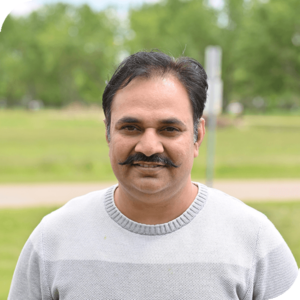
I am graduate in Plant Sciences from the University of British Columbia in Vancouver, where I was under the mentorship of Dr. Gurcharn Brar. Prior to my time in Canada, I was actively engaged in plant genomics research at esteemed institutions such as the National Institute of Plant Genome Research in New Delhi and Punjab Agricultural University in Ludhiana.
Subsequently, I contributed to the International Wheat Genome Sequencing Consortium project at Punjab Agricultural University before pursuing graduate studies in functional pathogenomics at UBC.
My research focuses was on functional pathogenomics of oat crown rust. While equipped with expertise in Bioinformatics, my tenure at UBC broadened my knowledge in rust pathosystems. (Oat and Wheat), molecular biology techniques, and fieldwork. Dr. Brar himself trained me in identification of various rust, collection and bulking it up and conducting field assessments (scoring). I conducted crop disease surveys in the Peace River region of British Columbia and Alberta for two consecutive years, enhancing my understanding of crop disease identification.
After graduation, I joined the Cereal Breeding Lab at the University of Alberta in March 2024, where I am currently immersed in the 2024 seeding trial of the wheat breeding program. My passion for wheat breeding continues to grow with each passing day. Outside of research, Ienjoy exploring places with natural beauty, playing volleyball, and badminton.